
Experiencing unexpected bleeding on HRT? Learn why spotting can happen after starting or changing treatment, what's expected, and when to get checked.

Experiencing unexpected bleeding on HRT? Learn why spotting can happen after starting or changing treatment, what's expected, and when to get checked.
Bleeding on HRT is common during the first six months of treatment or after a dose change, as the uterine lining adjusts. But bleeding that starts after months on a stable regimen, becomes heavy, or happens after menopause outside an expected withdrawal bleed needs medical attention. Tell your prescribing clinician about any unexpected bleeding.
You started hormone replacement therapy (HRT) to feel better. Maybe your hot flashes were finally improving, or you were sleeping through the night again. Then you noticed spotting.
Maybe it's just a little pink when you wipe. Maybe it feels like your period is back. Or perhaps you recently changed your HRT dose, and now you're wondering whether something is wrong.
The good news is that bleeding doesn't necessarily mean your treatment isn't working.
What matters is when the bleeding started, which hormones you're taking, and whether you've reached menopause.
Why does HRT cause bleeding?
HRT affects the lining of your uterus.
Estrogen helps build that lining, while progesterone helps regulate it. If you have a uterus and take systemic estrogen, you generally also need progesterone or another appropriate progestogen to protect the uterine lining.
When you start or change treatment, that balance can shift. Your body may respond with spotting or unexpected bleeding.
Here are five possible reasons.
1. Your body is adjusting to HRT
Starting estrogen and progesterone introduces a new hormone regimen.
During the first few months, your uterine lining may take time to adjust. Light spotting can be a temporary side effect.
The British Menopause Society (BMS) recognizes an adjustment period during the first six months of treatment. For women without endometrial cancer risk factors, clinicians may recommend changes to the HRT regimen while monitoring the bleeding.
That doesn't mean you should wait six months to tell your doctor. Let them know when bleeding starts so they can assess whether it's appropriate to monitor.
2. You recently changed your HRT dose
Did your doctor increase your estrogen because your hot flashes returned? Did you switch from a pill to a patch?
Bleeding after changing an HRT dose or preparation can happen because the uterine lining is responding to the new regimen.
It's one reason your clinician may review both your estrogen and progesterone prescriptions when unexpected bleeding begins.
If you're also experiencing returning symptoms or new side effects, our guide to how to know if your HRT dose is right explains what else to discuss with your clinician.
3. Your progesterone regimen may need review
Progesterone helps protect the uterine lining from the effects of estrogen.
If the type, dose, or schedule isn't appropriate for your estrogen treatment, you may experience unexpected bleeding. Missing prescribed doses can also contribute.
But bleeding doesn't automatically mean you need more progesterone.
Your doctor will need to review your medications and determine whether an adjustment or further investigation is appropriate.
Don't change your HRT dose on your own to try to stop the bleeding.
4. You're still having natural hormonal fluctuations
If you're in perimenopause, your ovaries may still produce estrogen and progesterone. Some months you may ovulate, and others you may not.
HRT doesn't necessarily stop these natural changes.
This means bleeding could be related to your menstrual cycle, your treatment, or both.
If you're experiencing irregular bleeding unrelated to a recent HRT change, our guide to perimenopause spotting explains other possible causes.
5. Your progesterone type, or something else entirely
Not all progesterone products work the same way.
Compounded progesterone creams, including some products marketed as bioidentical, may not be absorbed reliably enough to protect the uterine lining. The Menopause Society and British Menopause Society recommend using appropriately regulated hormone preparations rather than assuming compounded creams provide adequate protection.
Bleeding can also come from causes unrelated to your HRT dose.
These include cervical or vaginal changes, uterine polyps, fibroids, and sometimes medications such as blood thinners.
That's why your clinician may recommend an examination rather than simply changing your prescription.
Is bleeding on HRT normal?
Sometimes. The key is understanding what bleeding is expected with your particular treatment.
There are two common types of HRT regimens.
Cyclical or sequential HRT: You take estrogen regularly and progesterone for part of the month. A predictable withdrawal bleed may be expected after the progesterone portion ends.
Continuous combined HRT: You take estrogen and progesterone continuously. The goal is generally to avoid bleeding, although spotting can happen when starting or changing treatment.
Here's how to think about different patterns.
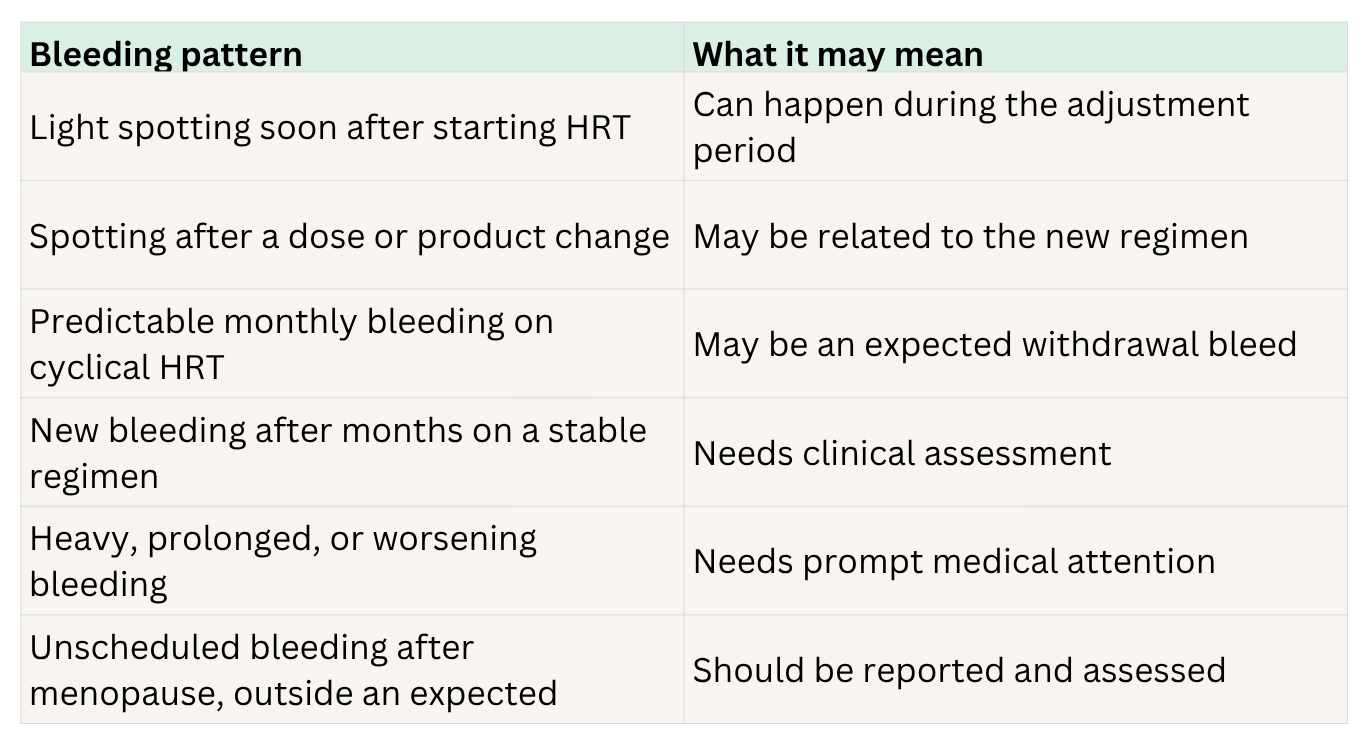
The same bleeding pattern can mean different things depending on your treatment and medical history.
How long does bleeding after starting or changing HRT last?
Light spotting may settle as your body adjusts, but there isn't one timeline that applies to everyone.
The British Menopause Society provides these recommendations for unscheduled bleeding:
During the first six months of HRT: If you have no endometrial cancer risk factors, your clinician may recommend treatment adjustments and monitoring.
After changing your HRT dose or preparation: Spotting may occur during the adjustment period. If bleeding begins early and persists, your clinician may continue adjusting treatment in low-risk cases. If bleeding first appears more than three months after a change, the BMS recommends an urgent vaginal ultrasound, generally within six weeks.
After six months on a stable HRT regimen: New unscheduled bleeding warrants investigation. The BMS recommends an urgent vaginal ultrasound within six weeks.
Heavy or prolonged bleeding: This may require earlier investigation regardless of how recently you started or changed HRT.
Your individual risk factors matter. Women with certain medical histories may need testing sooner.
If you've recently started treatment, our guide to the first 90 days of HRT explains other changes you may notice during the adjustment period.
When should you worry about bleeding on HRT?
Most bleeding episodes on HRT are not caused by cancer. Still, unexpected bleeding can occasionally signal a condition that needs treatment.
Contact your doctor if:
- You develop bleeding after months without bleeding on a stable regimen.
- Your spotting continues, becomes more frequent, or gets heavier.
- You experience bleeding after sex.
- You have new pelvic pain alongside bleeding.
- You're unsure whether your bleeding is expected with your HRT regimen.
- You have concerns about your progesterone prescription or schedule.
Seek urgent medical attention if you're soaking through a pad every hour for more than two hours, particularly if you feel faint, dizzy, weak, or short of breath. Severe pelvic pain also requires urgent assessment.
Remember that HRT is not contraception. If pregnancy is possible, take a pregnancy test and contact your clinician.
What if you've already reached menopause?
If you've reached menopause, a scheduled withdrawal bleed on cyclical HRT may be expected.
Any other bleeding should be reported, including new or persistent unscheduled bleeding on continuous combined HRT.
Possible causes range from changes in vaginal tissue to uterine polyps or problems with the uterine lining. Occasionally, bleeding can be a sign of cancer.
Your clinician will determine whether you need a pelvic examination, vaginal ultrasound, or a sample of the uterine lining.
ACOG updated its guidance in 2026 to recommend both vaginal ultrasound and tissue sampling during the initial evaluation of most patients with postmenopausal bleeding.
However, clinicians also consider HRT-specific guidance. Someone experiencing light spotting shortly after starting treatment may be managed differently from someone who develops new bleeding after a year on a stable regimen.
Your risk factors, type of HRT, and bleeding history all influence that decision.
Does bleeding mean your HRT dose is wrong?
Not necessarily.
Bleeding alone can't tell you whether you're taking too much estrogen, too little progesterone, or whether your treatment needs to change.
Two women taking similar medications can experience very different bleeding patterns.
That's because treatment response depends on several factors, including your natural hormone activity, the type of medication, how you take it, and how your body responds.
Your clinician will usually review your symptoms, prescription, timing, and bleeding history before deciding what to do next.
Bleeding is a reason to review your treatment, not proof that your dose is too high or too low.
How to track bleeding and hormone changes while on HRT
When something unexpected happens during treatment, it can be difficult to remember the details at your next appointment.
Did the spotting start before or after your estrogen increase? Was it just one day? Were your hot flashes improving at the same time?
Keeping a record can help you and your clinician see what changed.
Track these five things:
- Bleeding: When it starts, how long it lasts, and how heavy it is.
- Medication: Your HRT type, dose, schedule, and any changes or missed doses.
- Symptoms: Hot flashes, sleep, mood, energy, and other changes.
- Cycle timing: If you're still menstruating, note when bleeding occurs in your cycle.
- Other symptoms: Pelvic pain, bleeding after sex, or anything unusual.
Bring your notes to your appointment and ask whether the bleeding is expected with your regimen, whether your progesterone needs review, and whether additional testing is appropriate.
Can hormone tracking help?
Bleeding is one piece of the picture. What makes it useful is the context around it.
Oova measures three reproductive hormone markers at home: E3G, a marker of estrogen; PdG, a marker of progesterone; and LH.
Instead of seeing one measurement, you can follow how these markers change over multiple days and cycles.
One important thing to know if you're taking HRT: Your prescribed hormones can contribute to the same urinary markers Oova measures. Your results may reflect both your natural hormone production and your treatment.
That means Oova cannot reliably separate the two or tell you whether your bleeding is harmless or your HRT dose is correct.
What it can offer is a record of your measured hormone trends that you can discuss alongside your symptoms, medication changes, and bleeding history.
Your clinician can help determine whether those results are useful for your specific treatment.
Want to see your hormone trends over time?
Track Your Hormone Patterns With Oova
Frequently asked questions about bleeding on HRT
What is breakthrough bleeding on HRT?
Breakthrough bleeding, also called unscheduled bleeding, happens outside your expected bleeding pattern. Examples include spotting on continuous combined HRT or bleeding between expected withdrawal bleeds on cyclical HRT. It can happen during treatment adjustments, but persistent or newly developing bleeding should be discussed with your clinician.
How long does bleeding last after changing my HRT dose?
Spotting can happen during the first few months after a dose or product change. If bleeding first appears more than three months after the change, the British Menopause Society recommends an urgent vaginal ultrasound. Bleeding that starts earlier but persists also needs clinical follow-up, even though treatment adjustments may be appropriate in low-risk women.
Can HRT cause a period after menopause?
HRT can cause bleeding that resembles a period. Women taking cyclical HRT may have predictable withdrawal bleeding. Unexpected bleeding after menopause should be evaluated rather than assumed to be a normal period.
Should I stop HRT if I start bleeding?
Don't automatically stop or change your prescription without medical advice. Contact your prescribing clinician to discuss your symptoms. Depending on your bleeding pattern and medical history, they may recommend an adjustment or further testing.
Can I still bleed on HRT if I take progesterone?
Yes. Bleeding can happen even when you're taking progesterone correctly. Your regimen, recent medication changes, and other possible causes all matter. Unexpected bleeding doesn't automatically mean your progesterone isn't working.
The bottom line
Bleeding after starting or changing HRT can be unsettling, especially when you've finally started feeling better.
Sometimes it's a temporary response to treatment. Other times, it's a reason to investigate further.
You don't have to figure out which one it is on your own.
Tell your clinician about unexpected bleeding, keep track of when it happens, and make sure you understand which patterns are expected with your prescription.
Bring a clearer record to your next appointment
Changes during HRT can be easier to discuss when you have a record of what happened, not just what you remember.
Oova tracks your urinary estrogen, progesterone, and LH markers over time, giving you additional data to share alongside your symptoms and treatment history.
Track Your Hormone Patterns With Oova
Medical disclaimer: This article is for educational purposes only and does not replace medical advice, diagnosis, or treatment. Oova hormone tracking cannot rule out causes of abnormal bleeding or replace recommended clinical evaluation.
About the author
Sources
- British Menopause Society and partner organizations. Management of Unscheduled Bleeding on Hormone Replacement Therapy (HRT). Joint guideline, originally published April 2024; full guideline reviewed May 2026.
- American College of Obstetricians and Gynecologists. Clinical Practice Update: Updated Guidance Regarding the Role of Transvaginal Ultrasonography in Evaluating the Endometrium of Individuals With Postmenopausal Bleeding. Obstetrics & Gynecology, July 2026. Released April 2026.
- The North American Menopause Society. The 2022 Hormone Therapy Position Statement. Menopause, July 2022.
- British Menopause Society. Progestogens and Endometrial Protection. Post Reproductive Health, 2022.
- The Menopause Society. Hormone Therapy: Patient Education.
About the Oova Blog:
Our content is developed with a commitment to high editorial standards and reliability. We prioritize referencing reputable sources and sharing where our insights come from. The Oova Blog is intended for informational purposes only and is never a substitute for professional medical advice. Always consult a healthcare provider before making any health decisions.
