A clinical and practical comparison of the DUTCH test and daily at-home hormone tracking (Oova) for women in perimenopause or on HRT. Covers what each test measures, what it misses, when each is the right tool, and how to use both to build a complete hormone picture.
A clinical and practical comparison of the DUTCH test and daily at-home hormone tracking (Oova) for women in perimenopause or on HRT. Covers what each test measures, what it misses, when each is the right tool, and how to use both to build a complete hormone picture.
You've heard of the DUTCH test. Maybe your functional medicine doctor mentioned it, or you saw it in a perimenopause forum. You've also probably come across daily hormone tracking, the idea of testing your hormones at home, every day, and watching them move in real time.
Both are urine-based. Both measure hormones. Both are used by women who want more than a standard blood draw. So what's actually different between them, and more importantly, which one answers the question you're actually trying to answer?
Let's break it down honestly.
What Is the DUTCH Test?
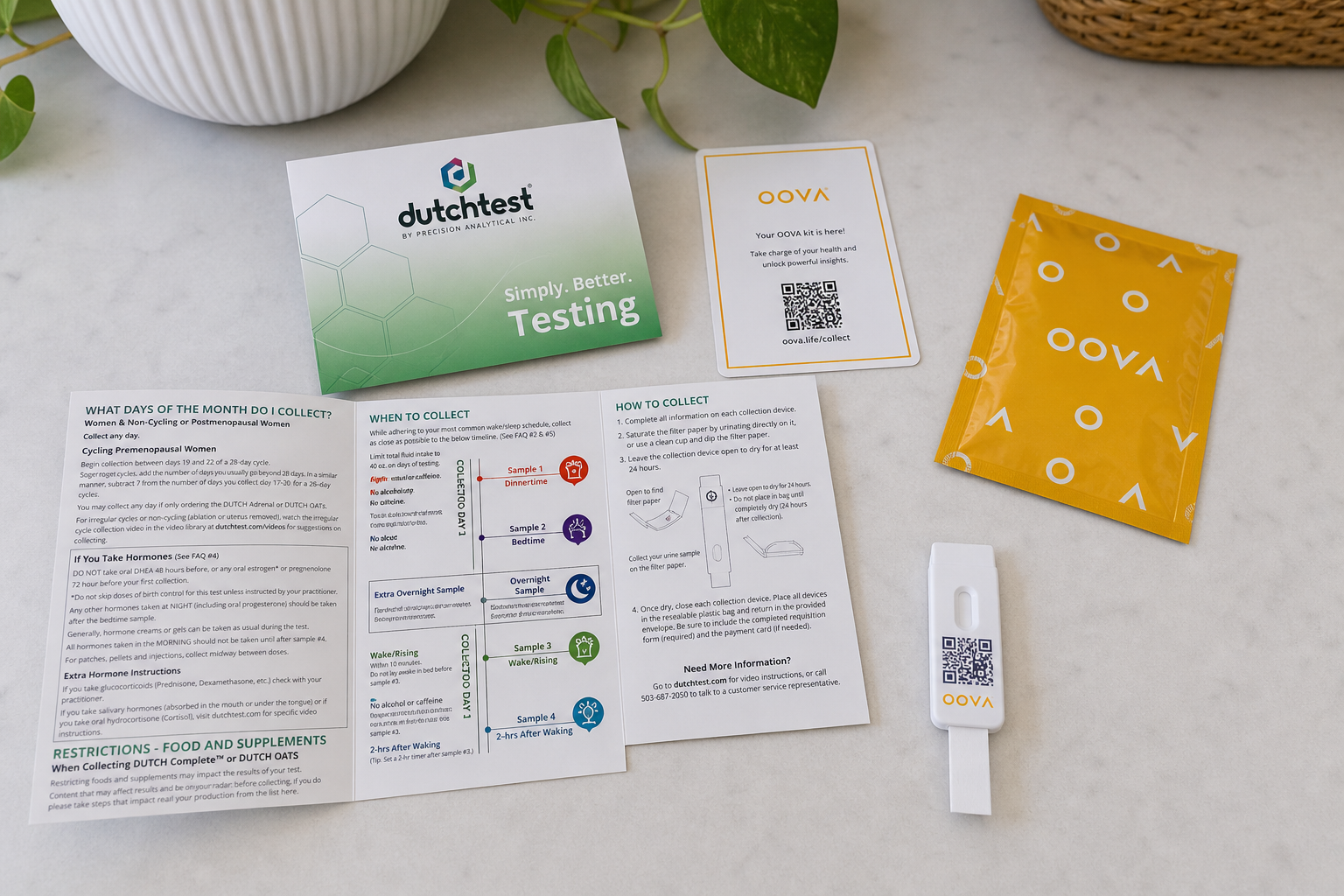
DUTCH stands for Dried Urine Test for Comprehensive Hormones. It's a specialty lab test developed by Precision Analytical that requires you to collect urine samples at four to five specific time points over a single 24-hour period, typically onto filter paper that you dry and mail to a lab. Results come back 1–2 weeks later as a detailed report.
What the DUTCH test measures:
- Estrogen (estradiol, estrone, estriol) and their metabolites (2-OH, 4-OH, 16-OH, which matter for estrogen detox pathways)
- Progesterone and its metabolites (including pregnanetriol and allopregnanolone, which relate to mood and GABA signaling)
- Androgens: DHEA-S, testosterone, and their metabolites
- Cortisol and cortisone, including a diurnal rhythm curve (4-point or 5-point collection)
- Melatonin (in the extended version)
- Organic acids that give insight into B vitamin status, oxidative stress, and neurotransmitter metabolism
The DUTCH test's strengths:
The DUTCH gives you a uniquely thorough snapshot of how your body is processing hormones, not just how much of them you have. The metabolite data, particularly the estrogen metabolism pathway breakdown, is something standard blood tests and basic urine tests cannot provide. If you've been told you have estrogen dominance but don't know whether the issue is production or clearance, DUTCH can help clarify that. It also captures cortisol rhythm across the day, which is clinically valuable for women dealing with adrenal fatigue patterns, chronic stress, or HPA axis dysregulation.
For functional medicine practitioners, DUTCH is often the first comprehensive view they order to understand the full hormonal landscape before designing a protocol.
What the DUTCH test cannot do:
Here is where the picture gets more nuanced, and where the "snapshot vs. pattern" question becomes critical.
The DUTCH test is a single-day collection. It tells you what your hormones looked like on that day, processed through that lab, reported two weeks later. In perimenopause, where estrogen and progesterone can shift dramatically not just cycle-to-cycle but week-to-week and sometimes day-to-day, a single collection point may not represent your hormonal reality. This is the same core problem we cover in depth in Why Your Hormones Look Normal but You Still Feel Terrible, a "normal" result on a given day can mask the very fluctuations that are driving your symptoms.
Consider: a woman whose estradiol ranged from 40 pg/mL to 280 pg/mL across a single cycle would get a single data point somewhere in that range. It might come back in the "low normal" range and suggest she doesn't need treatment, even though she's experiencing hot flashes because her estradiol is crashing, not because it's chronically low.
This is precisely what our own research has found. Single-moment readings miss the variability that defines perimenopause. A pattern is the only thing that truly tells the story.
What Is Daily Hormone Tracking?
Daily hormone tracking, as done through Oova, means testing your hormones at home, every day (or on a testing cadence matched to your cycle phase or HRT protocol), using a urine-based test strip scanned by your smartphone. Results are in under 10 minutes, and they populate directly into your app alongside your symptom log to build a longitudinal picture over time.
What Oova measures daily:
- Luteinizing hormone (LH)
- Estradiol (E2)
- Progesterone / PdG (urinary progesterone metabolite)
- FSH (in the perimenopause kit)
These are the core reproductive hormones whose patterns across time are what actually drive perimenopause symptoms, HRT absorption questions, and treatment optimization decisions.
Oova's clinical foundation:
Developed by Mount Sinai physicians and validated against blood lab standards, Oova's lab-grade urine testing is 99% as accurate as a blood test. That accuracy is foundational, the goal of daily tracking is meaningless if the individual data points aren't reliable.
The data is drawn from 35,000+ cycles across diverse users, which means your readings are interpreted against a reference set built specifically for women with irregular cycles, variable baselines, and the kind of hormonal complexity that a 28-day-cycle assumption would miss entirely.
Ready to see your hormone pattern, not just a snapshot? Oova tracks your estrogen, progesterone, and LH daily, with lab-grade accuracy from a simple at-home urine test. FSA/HSA eligible. Start Tracking My Hormones →
The Core Difference: Snapshot vs. Pattern
Here is the clearest way to understand the difference between these two tools:
The DUTCH test answers: "What does my full hormonal metabolite picture look like on this day, and how is my body processing these hormones?"
Daily tracking answers: "What are my hormones doing across time, and why do I feel better or worse on specific days?"
These are genuinely different questions. And for many women, particularly those in perimenopause or actively titrating HRT, the second question is the more urgent one.
Think about a woman on a transdermal estradiol patch. Her provider prescribed 0.05 mg. She's still having hot flashes. She wants to know: is the dose too low, or is it not absorbing consistently? A DUTCH test will tell her what was in her system on the collection day. But it won't tell her whether her levels vary by where she placed the patch, whether she absorbs better on certain days, or what her estradiol does in the 24 hours before she changes the patch. Daily tracking does. (For more on interpreting your HRT response, see our guide on how to know if your HRT dose is right, and if your symptoms have returned after an initially good response, why HRT stops working walks through the most common reasons.)
Cost and Accessibility
DUTCH test: Typically $299–$499 out of pocket, depending on the version (complete, plus, adrenal). Most insurance does not cover it. You need a practitioner to order it in most cases and to interpret the 30+ page report. Without clinical context, the metabolite data can be overwhelming or even misleading.
Oova: FSA/HSA eligible, with flexible subscription options. Results are available in under 10 minutes with app-based interpretation built in. No practitioner order required, though results can be shared directly with your provider via HIPAA-compliant dashboard with one click.
What Each Test Is Best For
Choose the DUTCH test when:
- You want to understand your estrogen metabolism pathways (2-OH vs. 16-OH, methylation capacity)
- You are dealing with suspected adrenal dysregulation and need a cortisol rhythm curve
- You are working with a functional medicine or integrative provider who uses metabolite data to design a protocol
- You want to understand androgens and their downstream conversion (testosterone → DHT, DHEA → androgens)
- You are investigating neurotransmitter-adjacent data (melatonin, B vitamin markers in the extended panel)
Choose daily tracking when:
- You are in perimenopause and want to understand why your symptoms fluctuate
- You have just started HRT and want to track how your hormones respond week over week (see our complete guide to what your hormones should look like in the first 90 days of HRT)
- You want to know whether your HRT is absorbing correctly, not just whether you're taking it
- You want to build a longitudinal dataset your provider can actually use to make dose adjustments
- You suspect your hormones are driving your symptoms but your FSH, AMH, and estradiol labs came back "normal," and you want to understand why single-timepoint tests miss the full picture (also see Day 3 Testing vs. Continuous Monitoring for a deeper dive into this diagnostic gap)
- You want to A/B test lifestyle changes, supplement protocols, or delivery method switches against real hormone data
Not sure if your HRT is actually working? Oova gives you daily estradiol and progesterone readings so you can see exactly how your body is responding, and bring real data to your next provider appointment. Get the Oova Perimenopause Kit →
Can You Use Both?
Yes, and for some women, using both at different points in their journey is genuinely useful.
A common pattern: a woman gets a DUTCH test to understand her estrogen metabolism and cortisol rhythm before starting HRT. That gives her and her provider a baseline metabolite picture. Then once she begins HRT, she shifts to daily tracking with Oova to monitor whether her levels are landing where they should, how consistently she's absorbing her dose, and whether her symptoms align with her hormone data on the days she feels worst.
In this sequence, the DUTCH answers the "what kind of hormonal terrain am I dealing with?" question, and Oova answers the ongoing "is my treatment working, and why do I feel the way I feel today?" question.
What DUTCH cannot replace is the day-to-day visibility that perimenopause management actually requires. Perimenopause is not a stable state you test once and manage from a single data point. It is, by definition, a transition, one defined by unpredictable fluctuation. The longitudinal pattern that daily tracking builds is the only data format that matches the biology.
A Note on What "Comprehensive" Really Means
The DUTCH test markets itself as comprehensive, and in the metabolite sense, it is. But "comprehensive" does not automatically mean "the right tool." A woman experiencing five different levels of hot flashes in a single week doesn't need to understand her 2-OH/16-OH estrogen ratio to know something is wrong. She needs to see that her estradiol dropped 60% between Tuesday and Thursday. That's what daily tracking delivers.
Real comprehensiveness, for a woman managing perimenopause, looks like: accurate data at enough frequency to see what's actually happening, correlated with symptoms, shareable with her provider, and actionable in real time. That's not a snapshot. That's a pattern.
As one Oova user put it: "I'm not just interested in what's considered 'normal,' I want to know what's optimal, how close I am to that, and what changes I can make."
That question requires longitudinal data. No single test, however thorough, can answer it.
See what a single test can't. Oova tracks your hormones daily, at home, in under 10 minutes, with 99% lab-grade accuracy. No needles. No appointments. FSA/HSA eligible. Start Tracking My Hormones →
The Bottom Line
.png)
If you're in perimenopause, on HRT, or trying to understand why your hormones fluctuate, daily tracking gives you something no single-point test can: the pattern behind the picture.
About the author
Sources
- Genazzani AR, et al. "Hormone fluctuations and symptom variability in perimenopause." Gynecological Endocrinology. 2021.
- Harlow SD, et al. "Executive Summary of the Stages of Reproductive Aging Workshop +10: Addressing the Unfinished Agenda of Staging Reproductive Aging." Journal of Clinical Endocrinology & Metabolism. 2012;97(4):1159–1168. (STRAW+10 staging criteria)
- Santoro N, et al. "Menopausal symptoms and their management." Endocrinology and Metabolism Clinics of North America. 2015;44(3):497–515.
- Prior JC. "Progesterone for symptomatic perimenopause treatment." Journal of Obstetrics and Gynaecology Canada. 2011;33(12):1236–1238.
- Stanczyk FZ. "All progestins are not created equal." Steroids. 2003;68(10-13):879–890. (Context: metabolite differences in hormone measurement)
- Precision Analytical. "DUTCH Complete Test: Interpretive Guide." precision-analytical.com.
- Oova. "Lab-grade hormone validation data." oova.life. (99% accuracy vs. blood test, developed by Mount Sinai physicians.)
About the Oova Blog:
Our content is developed with a commitment to high editorial standards and reliability. We prioritize referencing reputable sources and sharing where our insights come from. The Oova Blog is intended for informational purposes only and is never a substitute for professional medical advice. Always consult a healthcare provider before making any health decisions.