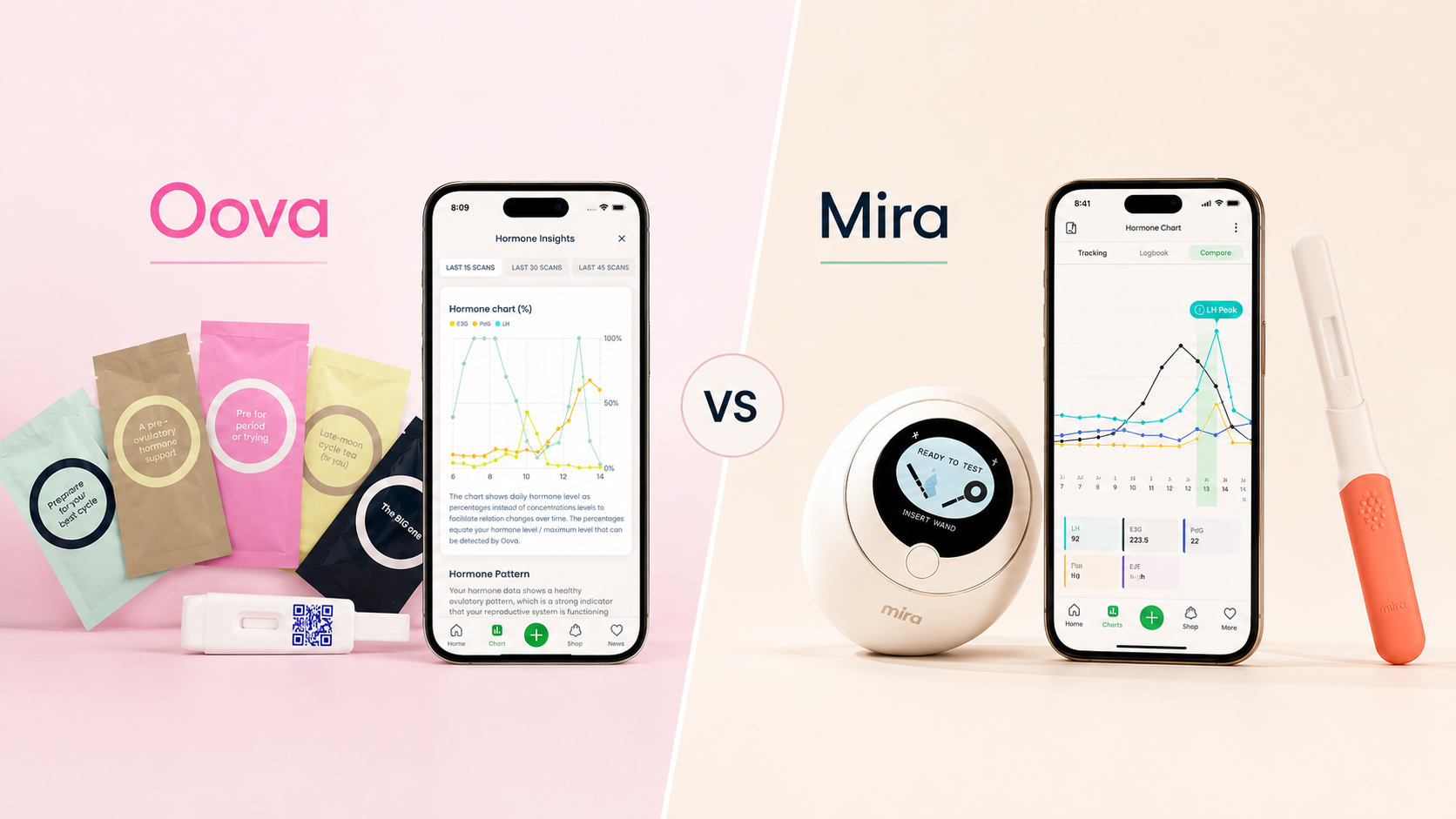
Looking for an alternative to Mira? See how Oova and Mira differ in hormones measured, testing hardware, fertility and perimenopause support, symptoms, wearable integration, and provider workflows.

Looking for an alternative to Mira? See how Oova and Mira differ in hormones measured, testing hardware, fertility and perimenopause support, symptoms, wearable integration, and provider workflows.
If you’re searching for a Mira alternative, you have several options depending on what you want to measure and what you want your hormone data to help you understand.
Mira, Oova, Inito, Proov, and Clearblue all approach at-home hormone or fertility tracking differently. Some are primarily designed around identifying fertile days, while others provide quantitative multi-hormone data or extend into perimenopause and broader hormone health.
This guide briefly covers the main Mira alternatives, then looks more closely at Oova and Mira, two platforms that overlap across quantitative hormone tracking, fertility, and reproductive health beyond trying to conceive.
Quick Answer: What Are the Main Alternatives to Mira?
If you’re looking for an alternative to Mira, options include:
- Oova: Quantitative LH, E3G, and PdG tracking across Fertility, Hormone Optimization, and Perimenopause, with smartphone scanning, Oura integration, and clinician sharing through Oova360, a HIPAA-compliant provider dashboard, with participating providers.
- Inito: Quantitative E3G, LH, PdG, and FSH tracking primarily focused on fertility and cycle tracking using a dedicated wireless reader.
- Proov: A full-cycle urine testing system that tracks FSH, E1G, LH, and PdG across the cycle using its testing kit and app.
- Clearblue: Fertility-focused ovulation testing that tracks E3G and LH to identify high- and peak-fertility days.
The right choice depends on whether your priority is fertility timing, the number of hormones measured, hardware, symptom context, perimenopause, wearable data, or how you want to use your results with a healthcare provider.
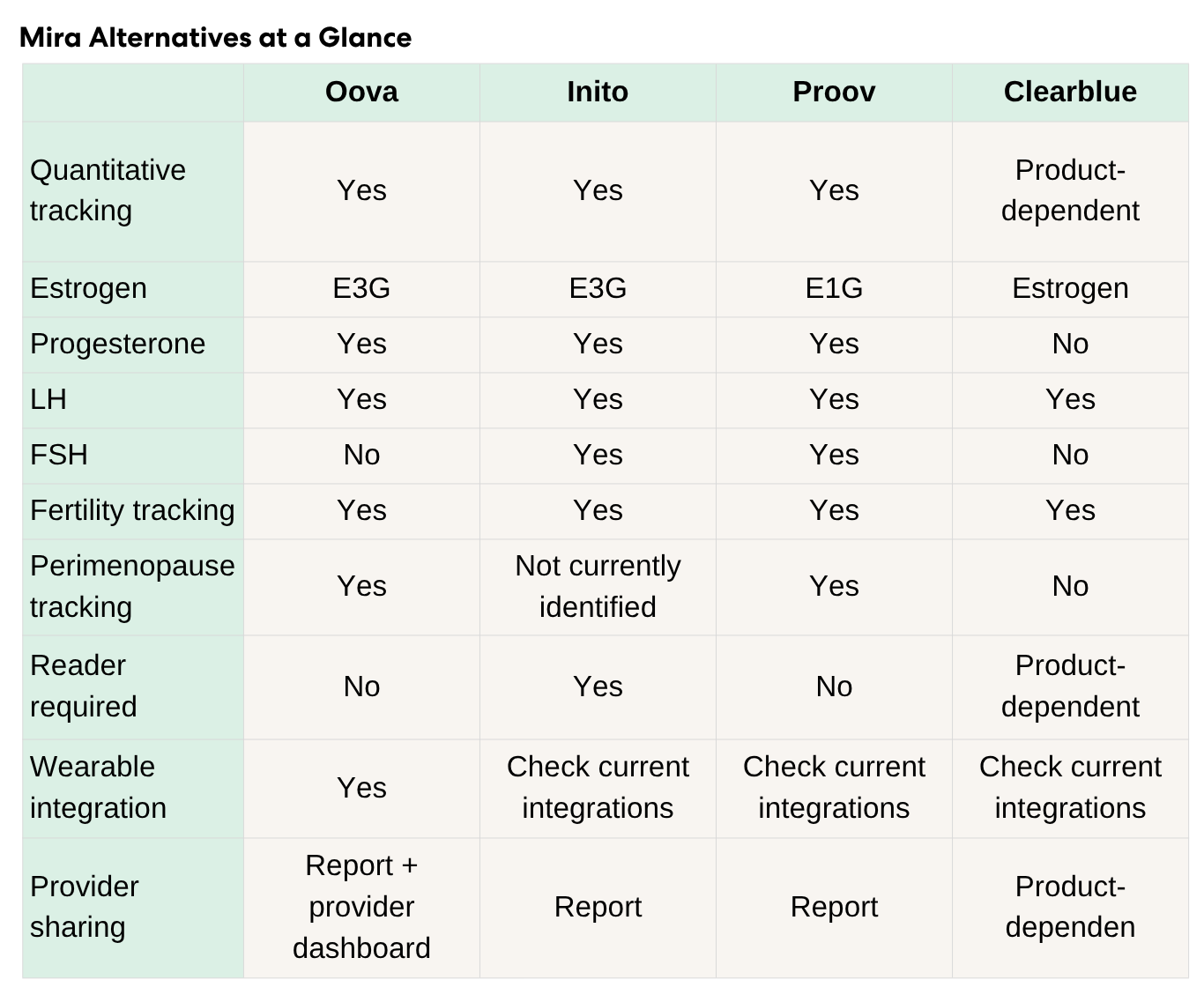
Product features and offerings change. This comparison reflects publicly available information reviewed in September 2026.
What Is Mira?
Mira is a quantitative at-home hormone monitoring system that uses disposable testing wands with a dedicated Mira Monitor. Its Ultra4 system measures: LH, E3G, PdG and FSH.
Mira offers both fertility tracking and a dedicated menopause-transition experience. Its current perimenopause offering lets users track hormone patterns, symptoms, lifestyle factors, and medications together and provides reports that can be shared with a healthcare provider.
For someone who specifically wants FSH measured alongside LH, E3G, and PdG, Mira’s Ultra4 system offers that capability.
If you’re deciding specifically between these two products, read our full Oova vs. Mira comparison.
Other Mira Alternatives to Consider
Oova
Oova measures LH, E3G, and PdG through at-home urine testing and is organized around three health journeys:
- Fertility
- Hormone Optimization
- Perimenopause
All three use the same core hormone-testing technology, while the app experience, insights, and dashboards change based on the user’s goal.
Oova does not require a separate proprietary analyzer and also integrates with Oura to bring supported wearable data into the hormone-tracking experience.
We’ll compare Oova and Mira more closely below.
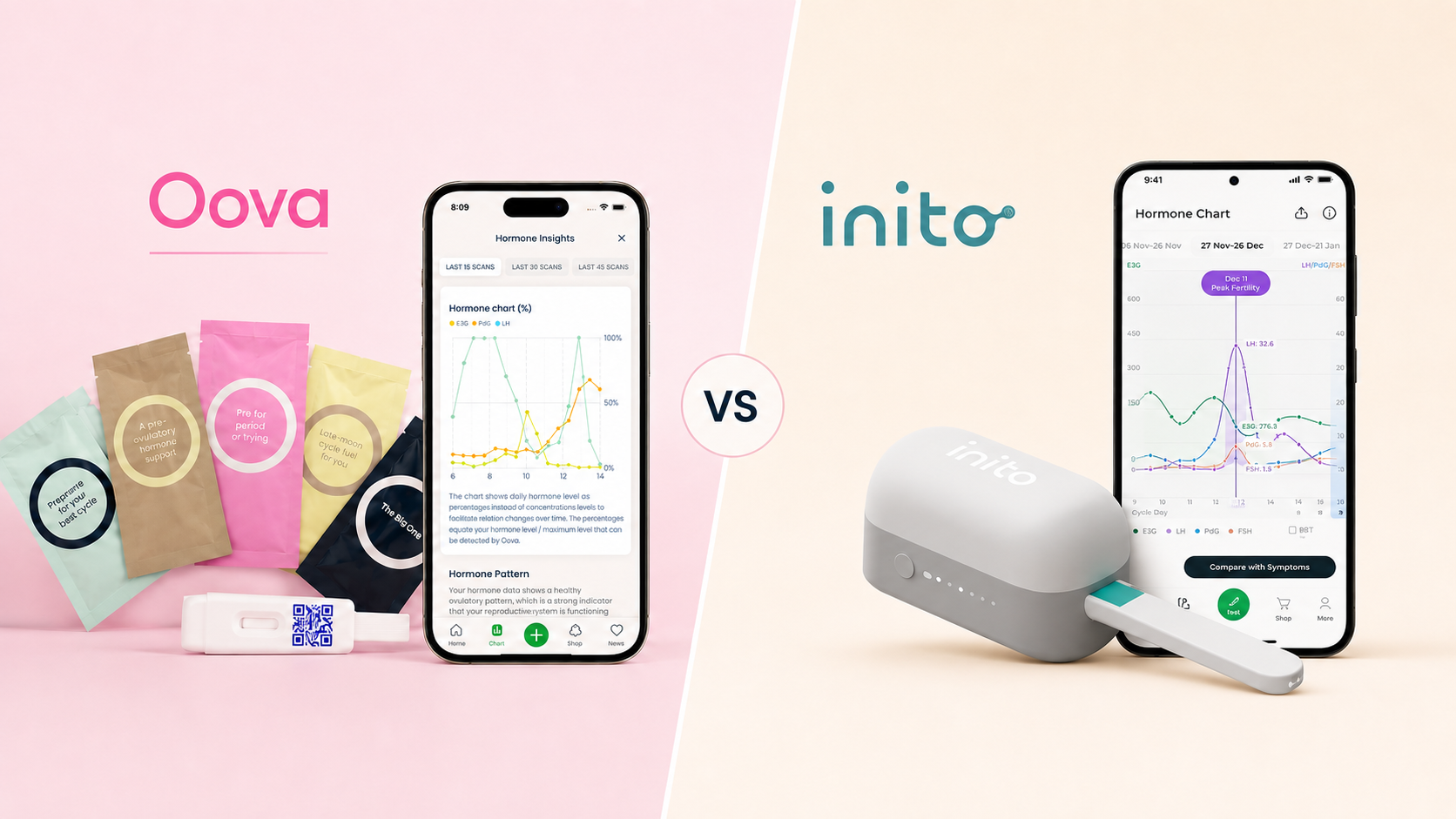
Inito
Inito is an at-home fertility monitor that measures E3G, LH, PdG, and FSH from one strip.
Its current InSight Wireless Reader is a standalone device compatible with iOS and Android and syncs results to the Inito app.
Inito’s current positioning is centered primarily on fertility and cycle tracking. It provides quantitative hormone values, identifies the fertile window, uses sustained PdG changes to assess ovulatory patterns, and allows users to track data across cycles.
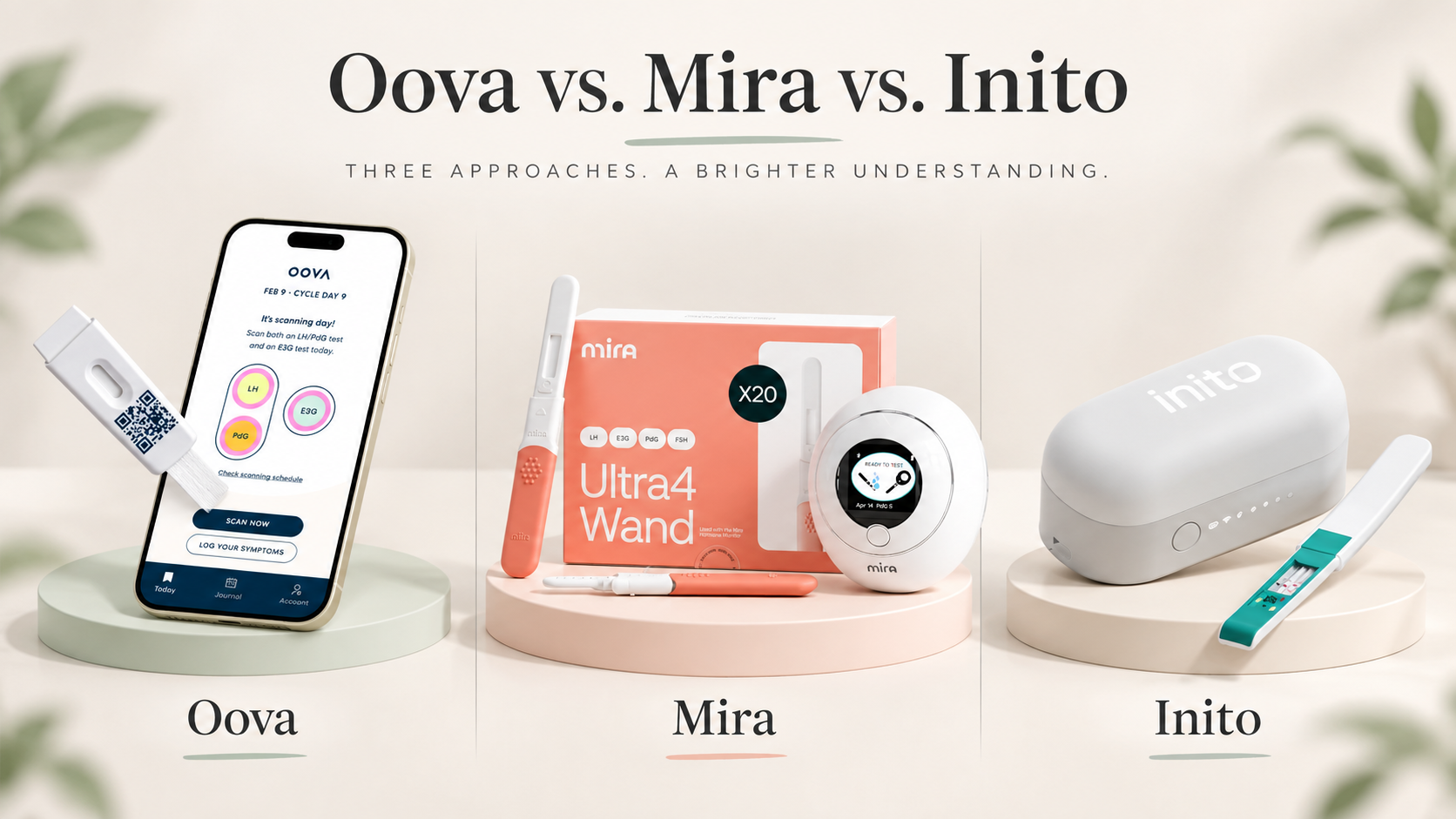
If you’re deciding among these three quantitative hormone monitors, see our Mira vs. Inito vs. Oova comparison.
Proov
Proov offers a portfolio of at-home hormone tests. Its Complete Fertility Testing System measures FSH, E1G, LH, and PdG across a cycle. The strips are read through the Proov app using a smartphone camera, and users receive hormone charts and an end-of-cycle report that can be saved or shared with a healthcare provider.
Proov also offers other products built around specific hormone or reproductive-health questions, including perimenopause-related offerings.
Proov may therefore appeal to someone who wants app-based urine testing without purchasing a dedicated electronic reader.
Clearblue
Clearblue takes a somewhat different approach. Its Advanced Digital Ovulation Test detects estrogen and LH to identify high- and peak-fertility days. Clearblue says the product typically identifies four or more fertile days and is more than 99% accurate at detecting the LH surge.
That makes Clearblue more relevant to someone primarily looking to identify their fertile window rather than someone specifically seeking longitudinal quantitative tracking across several reproductive hormones.
Why Compare Oova and Mira More Closely?
The alternatives above solve somewhat different problems. Oova and Mira overlap more directly because both provide quantitative hormone tracking and have dedicated experiences that extend beyond TTC into perimenopause.
They differ more in:
- which hormones they measure
- whether separate hardware is required
- how symptoms are incorporated
- wearable connectivity
- how users and clinicians access longitudinal data
Those differences can make one workflow more relevant than another depending on your goals.
Oova vs. Mira at a Glance
.png)
Features change over time. This comparison reflects publicly available product information reviewed in September 2026.
What Is Oova?
Oova is an at-home hormone monitoring platform designed to track longitudinal hormone patterns rather than relying on a single measurement or calendar prediction.
Oova measures: LH, E3G and PdG.
Those are the same three core reproductive hormone markers that Oova tracks across all of its health journeys.
The difference is what the app does with the information.
Fertility
The fertility experience helps users follow cycle patterns, fertile-window changes, and hormone changes around ovulation.
Hormone Optimization
Hormone Optimization is specifically designed around connecting symptoms with hormone patterns.
Its dashboard includes hormone and symptom trends over time, symptom-focused Hormone Insights, and a symptom-hormone correlation experience.
Perimenopause
Oova’s perimenopause experience uses longitudinal E3G, LH, and PdG patterns alongside cycle and symptom context.
Users can switch among Oova’s health journeys as their goals change.
Why Consider Oova as a Mira Alternative?
There isn’t one hormone monitor that makes sense for everyone.
The more useful question is: What do you want your hormone data to help you understand?
Here are some of the ways Oova and Mira differ.
1. Oova Does Not Require a Separate Hormone Analyzer
Mira uses a dedicated Mira Monitor to analyze its testing wands. Its current Ultra4 Perimenopause kit includes the monitor plus Ultra4 wands. Oova uses a different workflow.
Oova tests are scanned using a smartphone, so users do not need to purchase and maintain a separate proprietary electronic reader. Neither approach is inherently better.
Some users prefer dedicated hardware. Others may prefer having fewer devices involved in their testing routine.
2. Oova Has a Dedicated Experience for Hormone Questions Outside TTC
Both Oova and Mira have expanded beyond fertility.
One distinction is that Oova has a separate Hormone Optimization journey specifically designed for users whose primary goal is understanding symptoms and longitudinal hormone patterns rather than fertility or reproductive staging.
For example, someone may be asking:
- Why has my cycle changed?
- Are certain symptoms appearing alongside my hormone changes?
- Do my hormone patterns look different from month to month?
- What happened after I started or stopped something that could affect my cycle?
- What information would be useful to bring to my healthcare provider?
Oova’s Hormone Optimization dashboard is designed around those kinds of questions.
For more on why several measurements can provide different information than one snapshot, read How Long Do You Need to Track Hormones to See a Real Pattern?
3. Both Platforms Include Symptoms, but Oova Has a Symptom-First Journey
Mira deserves credit here: it does include symptoms. In its current Menopause Transition experience, Mira lets users track hormone patterns alongside symptoms, lifestyle factors, and medications.
Oova also incorporates symptoms, but additionally has a dedicated Hormone Optimization journey where the central experience is designed around how symptoms and hormone patterns move together over time.
That distinction may matter if fertility isn’t the reason you started looking at hormone trackers in the first place.
If you’re trying to understand symptoms that don’t have an obvious explanation, read Are My Symptoms Hormonal or Something Else?
4. Oova Integrates With Wearables
Hormones aren’t the only data many people track. Sleep, recovery, symptoms, and cycle changes can provide additional context when looking at patterns over time.
Oova integrates directly with Oura, allowing supported Oura sleep and readiness data to be viewed alongside hormone and symptom information.
That can help users explore questions such as:
- Does my sleep change at certain points in my cycle?
- Do changes in readiness overlap with changes in hormone patterns?
- Are symptoms, sleep, and hormone changes occurring at similar times?
If wearables are important to you, read Your Sleep Didn't Change. So Why Did Your Oura Score Drop? or Can Hormones Affect Recovery?
5. Both Platforms Can Support Conversations With Your Healthcare Provider
This is another area where the products overlap rather than one being categorically better.
Mira lets users download reports with hormone information to review with healthcare providers. Its perimenopause materials specifically emphasize bringing hormone patterns and symptom information into doctor conversations.
Oova provides reports as well and also offers a HIPAA-compliant provider dashboard.
The difference is more about how the data are accessed and incorporated into the workflow.
Learn more about Oova for healthcare providers →
6. Mira Measures FSH; Oova Currently Does Not
This is an important distinction and one that should be stated clearly.
Mira Ultra4 currently measures: LH + E3G + PdG + FSH
Oova currently measures: LH + E3G + PdG
If routinely measuring FSH at home is one of your main priorities, Mira’s four-hormone system may be particularly relevant.
But hormone count is only one consideration when choosing a monitor. Other considerations include:
- how often and when you test
- whether you want separate hardware
- how symptoms are incorporated
- what health journey you are following
- what you want to do with the data afterward
Oova vs. Mira for Fertility
For someone trying to conceive, both platforms provide more hormone information than an LH-only ovulation predictor kit. Both measure: LH, E3G, PdG Mira Ultra4 additionally measures FSH. Because both systems track PdG in addition to LH, users can follow hormone changes after the LH surge rather than relying exclusively on an LH result.
For a deeper explanation of why that matters, read Did I Actually Ovulate? How to Know for Sure.
Oova vs. Mira for Perimenopause
Both Oova and Mira currently offer dedicated perimenopause experiences. That’s important because Mira should not be described as simply a fertility tracker anymore.
Mira's Ultra4 Perimenopause product measures LH, E3G, PdG, and FSH and lets users follow hormones, cycle patterns, symptoms, lifestyle factors, and medications.
Oova's perimenopause experience follows E3G, LH, and PdG longitudinally alongside symptoms and reproductive-stage context.
The products therefore differ more in their testing systems, hormone selection, data integrations, and workflow than in whether they address perimenopause at all.
One additional distinction is intended use. Mira states that its Menopause Transition Kit is intended for hormone tracking and personal cycle awareness and is not intended to monitor, assess, or evaluate response to HRT or other medical treatment.
At the same time, Mira explicitly says users on HRT can track patterns, symptoms, and medications and share those patterns with their healthcare provider.
Oova's current support materials state that users can use Oova while on HRT under clinician guidance and follow hormones and symptoms over time.
If perimenopause is your primary reason for testing, you may also want to read Can You Be in Perimenopause With Regular Periods?
Oova vs. Mira for Irregular Cycles
Both Oova and Mira can be used in the context of changing or irregular cycles. Rather than relying exclusively on a calendar prediction, both products collect actual urinary hormone measurements.
For Oova, the platform uses personalized scanning plans rather than assuming every user follows the same cycle pattern.
Mira similarly describes its perimenopause system as useful across changing and irregular cycle patterns.
If irregularity is your main reason for tracking, the more useful comparison may therefore be:
- which hormones you want to measure
- which hardware setup you prefer
- whether fertility or broader hormone health is your main goal
- whether wearable context matters to you
- how you want to share the data with a provider
When Might Mira Be a Good Fit?
Mira may be relevant if you:
- Want FSH measured alongside LH, E3G, and PdG
- Prefer a dedicated electronic analyzer
- Want Mira’s Ultra4 system
- Want a platform with both fertility and menopause-transition experiences
- Prefer Mira's particular app and reporting workflow
When Might Oova Be a Good Fit?
Oova may be relevant if you:
- Want quantitative LH, E3G, and PdG tracking without purchasing a separate proprietary analyzer
- Want hormone tracking that extends beyond TTC
- Want a dedicated Hormone Optimization experience
- Want to examine symptoms alongside longitudinal hormone patterns
- Want a dedicated perimenopause experience
- Already use Oura and want supported wearable information incorporated into your hormone-tracking experience
- Want access to Oova360 when working with a participating healthcare provider
- Want to move among Fertility, Hormone Optimization, and Perimenopause within the same platform as your goals change
Still Comparing Your Options?
If your decision is specifically between Oova and Mira, read the full Oova vs. Mira: Which Hormone Monitor Is Right for You? comparison.
If you’re also considering Inito, read Mira vs. Inito vs. Oova: Which At-Home Hormone Monitor Is Best for You?
And if your main question is what hormone patterns actually tell you over time, read How Long Do You Need to Track Hormones to See a Real Pattern?
Frequently Asked Questions
What is a good alternative to Mira?
Several at-home hormone and fertility testing options may be worth considering, including Oova, Inito, Proov, and Clearblue. They serve somewhat different purposes. Oova provides quantitative LH, E3G, and PdG tracking across Fertility, Hormone Optimization,and Perimenopause without requiring a separate proprietary analyzer. Inito measures E3G, LH, PdG, and FSH using a dedicated reader and is primarily centered around fertility and cycle tracking. Proov's Complete system measures FSH, E1G, LH, and PdG using app-read urine tests. Clearblue offers a more fertility-window-focused approach using estrogen and LH.
Is Oova the same as Mira?
No. Both provide quantitative at-home hormone tracking, but their testing systems and product experiences differ. Mira's Ultra4 system measures LH, E3G, PdG, and FSH using disposable wands and a dedicated Mira Monitor. Oova measures LH, E3G, and PdG and uses smartphone-based scanning rather than requiring a separate analyzer.
Does Mira measure more hormones than Oova?
Mira Ultra4 currently measures four hormone markers: LH, E3G, PdG, and FSH. Oova currently measures three: LH, E3G, and PdG. If FSH measurement is an important priority for you, that difference may matter.
Do Oova and Mira both support perimenopause?
Yes. Both currently offer dedicated perimenopause experiences. Their approaches differ in hormone selection, hardware, integrations, and overall product workflow.
Does Oova require a separate monitor?
No separate proprietary electronic analyzer is required. Mira's current Ultra4 system uses the Mira Monitor.
Can Oova connect with a wearable?
Oova currently integrates with Oura, allowing supported wearable information to be used alongside Oova hormone data.
Can I share Oova or Mira data with my doctor?
Yes. Mira allows users to download hormone reports for healthcare-provider conversations. Oova provides shareable information and also offers the Oova360 clinician-facing environment for participating providers.
The Bottom Line
Mira is a sophisticated quantitative hormone-monitoring platform, and for some users it may be exactly the right choice, particularly if four-hormone tracking including FSH and a dedicated analyzer are priorities.
But it isn't the only option. Inito, Proov, Clearblue, and Oova all offer different approaches to fertility or hormone tracking.
Oova may be worth considering if your priorities include longitudinal LH, E3G, and PdG tracking without a separate analyzer, symptom-focused hormone insights, dedicated Fertility and Perimenopause experiences, Oura integration, and clinician-facing longitudinal workflows.
About the author
Sources
- Mira. Ultra4 Hormone Monitor / Menopause Transition Kit. Mira product information on LH, E3G, PdG, FSH, monitor hardware, perimenopause use, symptom tracking, and HRT-related intended use. Mira Ultra4 Perimenopause Kit
- Mira. Doctor’s Report. Mira Help Center guidance on downloadable hormone, cycle, and symptom reports for healthcare providers. Mira Doctor’s Report
- Inito. Inito Fertility Monitor / InSight Wireless Reader. Product information on E3G, LH, PdG, FSH, fertile-window tracking, ovulation confirmation, and reader hardware. Inito Fertility Monitor
- Proov. Proov Complete Fertility Testing System. Product information on full-cycle FSH, E1G, LH, and PdG testing and app-based results. Proov Complete
- Clearblue. Advanced Digital Ovulation Test. Product information on E3G/estrogen and LH tracking, fertile-window identification, and LH surge detection. Clearblue Advanced Digital Ovulation Test
About the Oova Blog:
Our content is developed with a commitment to high editorial standards and reliability. We prioritize referencing reputable sources and sharing where our insights come from. The Oova Blog is intended for informational purposes only and is never a substitute for professional medical advice. Always consult a healthcare provider before making any health decisions.