
Weight gain, brain fog, and fatigue are often treated as separate problems. Emerging research suggests they may stem from the same underlying hormonal and metabolic changes. Learn how estrogen, insulin, and hormone fluctuations can influence multiple symptoms at once, and why looking for patterns may provide better answers than treating each symptom individually.

Weight gain, brain fog, and fatigue are often treated as separate problems. Emerging research suggests they may stem from the same underlying hormonal and metabolic changes. Learn how estrogen, insulin, and hormone fluctuations can influence multiple symptoms at once, and why looking for patterns may provide better answers than treating each symptom individually.
Weight gain. Brain fog. Fatigue.
Most women assume these are three separate problems requiring three separate solutions.
During perimenopause, they're often three symptoms of the same underlying hormonal and metabolic shift. That's why they tend to appear together, worsen together, and, when the right things are addressed, improve together.
One of the strongest clues that hormones are involved isn't one symptom, it's several symptoms appearing together. Weight gain, brain fog, fatigue, poor sleep, anxiety, and even heart palpitations often emerge together because they're being driven by the same underlying hormonal changes. For the anxiety, insomnia, and palpitations piece of this cluster, see why anxiety, insomnia, and heart palpitations often occur together.
If you went to the doctor and described the weight that arrived around your midsection without explanation, the fatigue that doesn't resolve with sleep, and the brain fog that makes you feel like you're thinking through cotton, and you were told these are separate concerns, this article is for you.
Are weight gain, brain fog, and fatigue connected?
Yes, and the connection is metabolic and hormonal, operating through several pathways simultaneously.
During perimenopause, fluctuating estrogen affects insulin sensitivity, cortisol regulation, mitochondrial function, and brain glucose metabolism. Together, these changes create the symptom cluster many women recognize as weight gain, brain fog, and fatigue. No single mechanism explains everything, but estrogen's influence across all four of these systems explains why the symptoms tend to cluster and move together.
Insulin sensitivity declines when estrogen is lower or more variable. Cells become less efficient at taking up glucose. Blood sugar spikes more readily after meals and drops more sharply afterward. That roller coaster of blood sugar instability drives post-meal fatigue, afternoon energy crashes, and cravings, and contributes to fat storage, particularly in the abdomen.
Cortisol regulation becomes less predictable as estrogen fluctuates. Cortisol helps regulate blood sugar and the body's stress response, but when estrogen is volatile, cortisol timing becomes less precise, contributing to abdominal fat storage, poor sleep, and fatigue at the wrong times of day.
Brain glucose availability fluctuates with blood sugar. The brain depends on consistent glucose supply, and even modest instability, not diabetic-range, just variable, can impair word retrieval, working memory, focus, and sustained attention.
Mitochondrial function appears to be supported by estrogen at the cellular level. As estrogen becomes less stable, the efficiency of cellular energy production may decrease, contributing to the fatigue women describe as different from ordinary tiredness: a heaviness that doesn't resolve with rest.¹
These four systems are all influenced by estrogen. When estrogen becomes unstable, all four can shift at once.
Why do these symptoms appear together?
The timing of symptom onset is often the most important clue.
When weight gain, brain fog, and fatigue all appear within the same six-to-twelve-month window, particularly in a woman's late 30s or 40s, and when no single behavioral change explains any of them, the most likely shared explanation is hormonal.
The underlying sequence typically looks like this:
Estrogen becomes more volatile. It spikes higher and drops lower than it used to across the cycle. This variability, more than any absolute decline, is what creates most of the early metabolic disruption.
Insulin sensitivity decreases in response to estrogen volatility. The body requires more insulin to manage the same glucose load. Blood sugar becomes more reactive.
Blood sugar instability creates post-meal fatigue and cognitive slowing. The brain, highly sensitive to glucose variability, doesn't function optimally when supply is inconsistent.
Fat storage shifts toward the abdomen. Cortisol, which rises to compensate for blood sugar drops, preferentially directs fat toward visceral storage.
Poor sleep, often driven by progesterone decline and blood sugar instability overnight, elevates cortisol further. Elevated cortisol worsens insulin resistance. Insulin resistance makes sleep worse. The cycle reinforces itself.
Weight gain, brain fog, and fatigue aren't three separate problems with three separate causes. They're three outputs of the same metabolic and hormonal disruption.
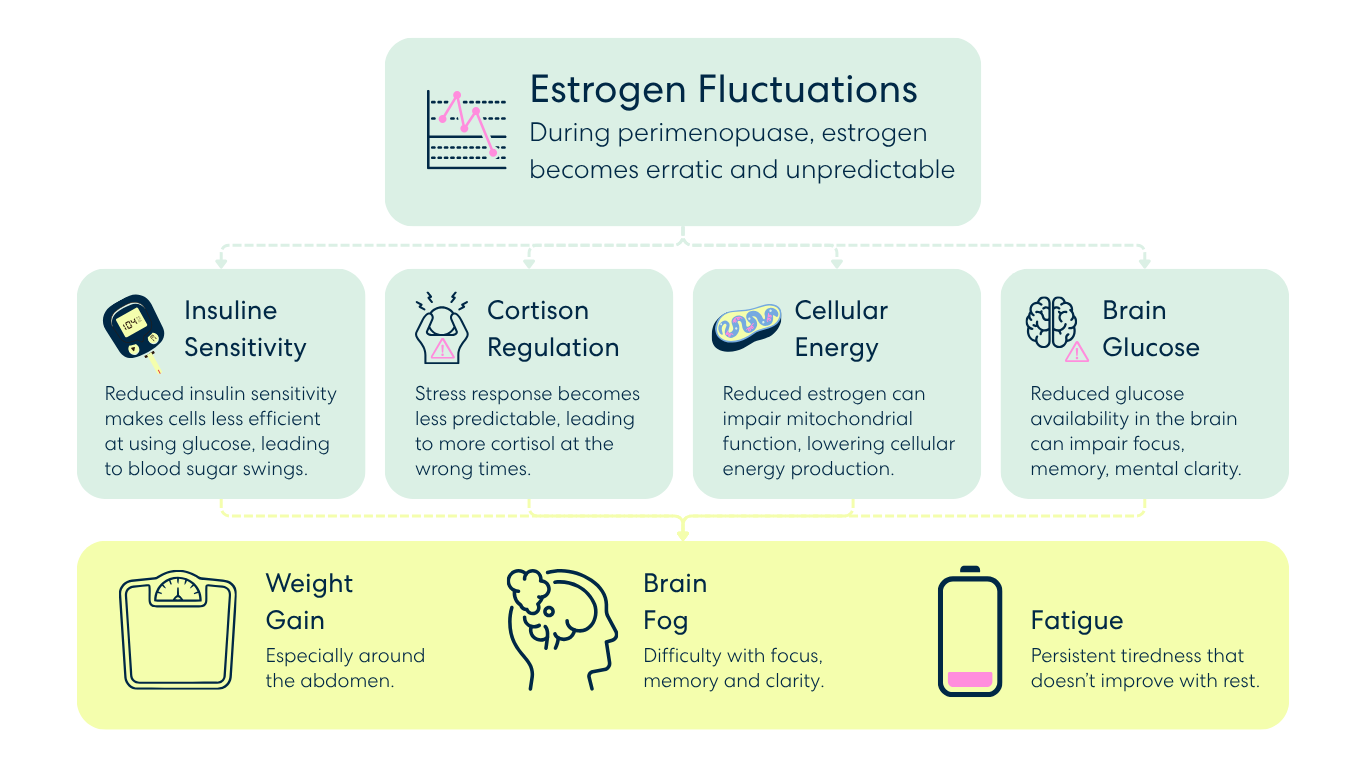
Each symptom reinforces the others, creating a cycle that's difficult to break without addressing the underlying hormonal and metabolic changes.
For a deeper look at how estrogen directly affects insulin sensitivity and why this relationship is so central to perimenopause symptoms, that article covers the mechanism in full.
Why weight gain happens even when nothing changed
This is the question that generates the most frustration, and the most self-blame.
The weight gain of perimenopause is specifically metabolic and hormonal, and it responds differently than weight gain driven by caloric excess. Several things are happening simultaneously:
Insulin resistance means more calories are stored as fat. When cells are less responsive to insulin, the body compensates with higher insulin output. Elevated insulin promotes fat storage, particularly visceral fat, which has more cortisol receptors and is more metabolically active than fat elsewhere.²
Visceral fat itself impairs insulin function further. It releases inflammatory cytokines that worsen insulin resistance, creating a circular pattern: hormonal change promotes visceral fat, visceral fat worsens the hormonal environment.
Cortisol directs fat to the abdomen. When blood sugar drops, which happens more frequently with impaired insulin sensitivity, cortisol rises to bring it back up. Cortisol chronically elevated toward the abdomen specifically.
Muscle mass declines. Estrogen supports muscle maintenance. As estrogen becomes less stable, muscle loss accelerates, often without visible change in weight. Lower muscle mass means less glucose disposal capacity, which compounds insulin resistance.
This is why blood sugar feels different during perimenopause isn't a secondary question, it's central to the weight picture. And it's why approaches that worked in previous decades often stop working: the hormonal driver behind fat storage is still running, and caloric adjustment alone doesn't address it.
Why brain fog is often metabolic, not psychological
Many women with perimenopause brain fog are told it's anxiety. Or depression. Or stress. Or just aging. All of these can contribute, but the metabolic driver is frequently overlooked.
The brain consumes approximately 20% of the body's total glucose despite representing only about 2% of body weight. It is disproportionately sensitive to glucose availability and consistency. When blood sugar is volatile, spiking after meals and then dropping, cognitive function tends to be volatile too.³
Women often notice this tracking: sharper in the morning before eating, foggier after lunch, worse in the late afternoon when blood sugar dips are common. Worse in the week before the period, when both estrogen and progesterone are at their lowest and blood sugar regulation is most impaired. Better in the follicular phase when estrogen is rising and insulin sensitivity is higher.
That pattern, cognitive performance that fluctuates with hormonal and metabolic state, is not psychological. It's physiological.
Estrogen also helps regulate neuroinflammation, another reason fluctuating hormone levels can make concentration and memory feel noticeably different during perimenopause. When estrogen is volatile, the brain's inflammatory environment becomes less stable, which may compound the cognitive effects of blood sugar variability.⁴
For many women, the brain fog of perimenopause is at least partially reversible, but not through cognitive training or stress management alone. Stabilizing the metabolic environment that the brain is operating in is often a necessary part of the picture.
Why fatigue is different in perimenopause
The fatigue of perimenopause is one of the most universally reported and least adequately explained symptoms. Women describe it as fundamentally different from ordinary tiredness, not resolved by sleep, not proportional to exertion, present even after a full night of rest.
Several mechanisms converge to produce this:
Sleep disruption. Declining progesterone removes the GABAergic calming effect on the nervous system that supports sleep continuity. Estrogen volatility disrupts temperature regulation overnight. Blood sugar instability can trigger cortisol surges at 2 to 3 AM that wake women in the second half of the night. The result is sleep that looks adequate in duration but is fragmented and non-restorative. For more on this, see how hormones affect your sleep.
Cellular energy production. Estrogen appears to support mitochondrial function, the energy production capacity of individual cells. As estrogen becomes less stable, the efficiency of cellular energy metabolism may decline. This contributes to the quality of fatigue women describe: not sleepy, but depleted.⁵
Chronic blood sugar volatility. The energy crashes after meals, the 3pm slump, the shakiness before eating, all of these represent blood sugar instability and its downstream effect on energy. A system that is constantly managing glucose spikes and drops is a system that has less capacity for sustained energy.
Declining muscle mass compounds all of the above. Because skeletal muscle is the body's largest site of glucose disposal, losing muscle during perimenopause further worsens insulin sensitivity and contributes to lower energy levels. Estrogen supports muscle maintenance, and as estrogen becomes less stable, muscle loss accelerates, often without a visible change in body weight.
HPA axis dysregulation. The interaction between declining estrogen, cortisol, and the stress response system becomes less precise during perimenopause. The result can be cortisol patterns that are dysregulated, too high at the wrong times, contributing to fatigue rather than energy.
None of these causes are addressable through willpower or behavioral change alone. They require understanding what's driving them.
Why these symptoms are often worse some weeks than others
The variability itself is often the most confusing part. Some weeks are manageable. Others feel unlivable. And the shift can happen seemingly without explanation.
The explanation is usually hormonal cycling and its metabolic downstream effects. Estrogen that swings higher in one part of the cycle creates different metabolic conditions than estrogen that drops sharply in another. The late luteal phase, when both estrogen and progesterone are at their lowest, tends to be when all three symptoms peak together: the worst brain fog, the highest weight on the scale, the heaviest fatigue.
Women often describe a near-cyclical pattern: feeling reasonably functional in the follicular phase, noticeably worse in the late luteal phase, and experiencing what feels like a reset when the period arrives. This pattern is a strong signal that the drivers are hormonal. For more on why perimenopause symptoms come and go in predictable patterns, that article goes deeper on the cycling mechanism.
As perimenopause progresses and cycles become more erratic, this pattern may become less predictable, which is why symptoms that were once cyclical can start feeling chronic.
Why standard testing often misses this
One of the most consistently reported experiences among women with this symptom cluster: labs come back normal.
Fasting glucose is normal. HbA1c is normal. Thyroid is fine. Estrogen, drawn once on day 3, doesn't indicate a problem. The doctor says everything looks fine.
This isn't a failure of medicine in bad faith. It's a fundamental limitation of snapshot testing applied to a pattern problem.
Fasting glucose doesn't capture postprandial variability, what happens to blood sugar after meals, which is where early insulin resistance most often appears. A single estrogen draw doesn't capture whether estrogen is spiking and crashing erratically across the cycle. A normal HbA1c doesn't capture the day-to-day volatility that affects brain function and energy.
The metabolic changes of perimenopause often appear in experience before they appear in standard lab values. By the time fasting glucose is flagged, insulin resistance may have been building for years.
What your doctor's hormone tests miss covers this gap in detail. Why your hormones look normal but you still feel terrible addresses the specific frustration of normal results alongside real symptoms.
What the pattern is telling you
Weight gain, brain fog, and fatigue appearing together, in your 40s, without clear behavioral explanation, is not a coincidence. It's a cluster.
Clusters matter because they point toward a shared cause. A shared cause is more efficiently addressed than three separate causes. And a shared cause that's hormonal and metabolic in nature requires understanding the pattern of your hormones over time, not a single measurement at a single point.
The four perimenopause hormone patterns that appear in Oova's real-world data each have their own symptom fingerprint, and each one produces a somewhat different version of this cluster. The weight gain that comes with an estrogen-dominant pattern looks different from the weight gain that comes with a progesterone-deficient pattern, even though both may produce fatigue and brain fog. Understanding which pattern you're in changes what interventions are worth trying.
If you've noticed something changed with your hormones and you can't point to a behavioral cause, the pattern of how symptoms cluster, cycle, and progress over time is usually the most informative dataset available.

Frequently Asked Questions
Why do I have brain fog and can't lose weight?
Brain fog and unexplained weight gain often occur together during perimenopause because estrogen influences both metabolism and brain function. Fluctuating hormones can affect insulin sensitivity, blood sugar regulation, sleep, and energy production simultaneously, which is why both symptoms tend to appear in the same window and respond to the same underlying hormonal changes.
Are weight gain, brain fog, and fatigue connected during perimenopause?
Yes. All three are frequently driven by the same underlying changes: estrogen volatility, declining progesterone, and the metabolic disruption those changes trigger, particularly around insulin sensitivity and blood sugar regulation. When these symptoms appear together in women in their 40s without clear behavioral explanation, a hormonal and metabolic root cause is worth investigating.
Can insulin resistance cause brain fog?
Yes. The brain depends on consistent glucose availability. When insulin resistance causes blood sugar to spike and drop more sharply after meals, cognitive performance tends to track those fluctuations, sharper before eating, foggier after meals or in the afternoon. This pattern is metabolic, not psychological.
Why am I gaining weight when nothing in my diet changed?
During perimenopause, declining estrogen alters insulin sensitivity, cortisol regulation, and fat storage patterns independently of caloric intake. Fat may accumulate preferentially in the abdomen, and standard dietary interventions may not produce the same results as they did before these hormonal changes occurred.
Why do I feel so tired even when I sleep enough?
Perimenopause-related fatigue often involves several overlapping factors: non-restorative sleep due to progesterone decline and overnight blood sugar volatility, reduced cellular energy efficiency as estrogen becomes less stable, and HPA axis dysregulation affecting cortisol timing. Sleep duration may be adequate while sleep quality is significantly impaired.
Why are these symptoms worse in the week before my period?
The late luteal phase, when both estrogen and progesterone are at their lowest, tends to be when insulin sensitivity is most impaired, sleep is most disrupted, and cortisol is most variable. All three symptoms typically peak in this window and may improve after the period begins.
Can hormone testing explain these symptoms?
Standard hormone testing, including a single estrogen draw and fasting glucose, often misses the variability and patterns that drive this symptom cluster. Postprandial blood sugar behavior, estrogen volatility across the cycle, and the cycle-to-cycle pattern of progesterone production are not captured by one-time measurements.
Does HRT help with weight gain, brain fog, and fatigue?
For some women, yes, particularly when these symptoms are driven by estrogen deficiency or volatility. For others, the response varies based on which hormones are involved, the formulation, and individual factors. For more on variability in HRT response, see why some women thrive on HRT while others don't, HRT and weight gain: what the research actually says, and The HRT Under-Response Pattern: When Treatment Isn't Working.
About the author
Sources
- Brinton RD. "Estrogen-induced plasticity from cells to circuits: predictions for cognitive function." Trends in Pharmacological Sciences. 2009;30(4):212–222.
- Lovejoy JC, et al. "Increased visceral fat and decreased energy expenditure during the menopausal transition." International Journal of Obesity. 2008;32(6):949–958.
- Craft S. "Insulin resistance and Alzheimer's disease pathogenesis." Neurobiology of Aging. 2005;26(Suppl 1):65–69.
- Sherwin BB. "Estrogen and cognitive functioning in women." Endocrine Reviews. 2003;24(2):133–151.
- Irwin RW, et al. "Progesterone and estrogen regulate oxidative metabolism in brain mitochondria." Endocrinology. 2008;149(6):3167–3175.
About the Oova Blog:
Our content is developed with a commitment to high editorial standards and reliability. We prioritize referencing reputable sources and sharing where our insights come from. The Oova Blog is intended for informational purposes only and is never a substitute for professional medical advice. Always consult a healthcare provider before making any health decisions.